In 2008, Energy Costs Spiked by 30 Percent in Just One Year!
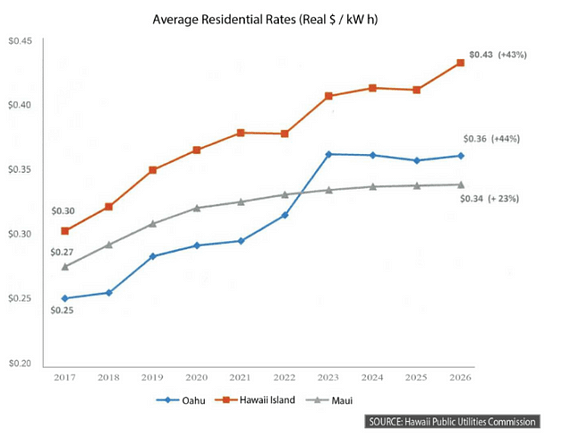
Electricity rates in Hawai‘i fluctuate radically based on unstable oil costs. In 2008, the average residential rate
for Maui residents was 0.36 cents per kilowatt (kW) hour, compared to 22.5 cents in 2005.
(learn more about electrical rates)
Why "go solar?" For one, a solar electric system will insulate your monthly energy costs against future rate increases.
Secondly, with a solar system, you will own your electricity generation, rather than "renting" it from the local utility.
How much will it cost? The cost of a solar system is contingent on the energy demand of your home. Today, the average cost
of a home system will range between $14,000 and $30,000. In most cases, if it is financed in a mortgage, the monthly payment
for the cost of a solar system will be far less than what you would have paid for your monthly electric bill. In addition,
federal and state tax incentives and rebates often pay for more than half of the cost of the solar system. On average,
most homeowners recover the cost of their solar system cost within 6 to 8 years, proving that this is one investment that
is safe, reliable and inflation adjusted.
Financial Incentives for Hawai‘i Residents to "Go Solar"
The federal government provides an unlimited 30 percent Federal Energy Tax Credit per year for residential solar systems installed
after Dec 31, 2008.
In addition, the state allows a 35 percent tax credit limited to $5,000 per year for a residential solar system. Customers may also
elect to take the state tax credit as a refund. The amount will be reduced to 24.5 percent, and the limit is $3,500 per system.
(Click here to see a Sample Financial Analysis.)
Please note that these tax incentive calculations are based on our understanding of the new energy conservation credits outlined in
the Solar Energy Industries Association (SEIA) Guide to Federal Tax Incentives for Solar Energy. Please click on the link below to
download the manual, or schedule a consultation with your tax professional.
You can also email your tax questions to Levin & Hu CPA Doug Levin.
Contact RSSE for a free site survey and quote at (808) 579-8287.
Tax credits that exceed the taxpayer's income tax liability may be used as a credit against the taxpayer's income tax liability in
subsequent years until exhausted.
Federal tax credit
State Tax Credit
Please note that the tax incentive calculations are based on our understanding of the new energy conservation credits described in the SEIA Guide to Federal Tax Incentives for Solar Energy. Please click on the link below to learn more about federal and state tax credits or consult your tax professional. You can also e mail your tax questions to Levin and Hu CPA Doug Levin.
Federal tax credit
State Tax Credit
Please note that the tax incentive calculations are based on our understanding of the new energy conservation credits described in the SEIA Guide to Federal Tax Incentives for Solar Energy. Please click on the link below to learn more about federal and state tax credits or consult your tax professional. You can also e mail your tax questions to Levin and Hu CPA Doug Levin.
Offset Energy Costs
Energy Savings: A Rising Sun Solar Electric system provides a monthly savings on your electric bill by replacing some or all
of your purchased utility kilowatt-hours (kW) with solar-generated electricity. These savings will depend on the size of the
installed system, location and the price of electricity, and will be realized every month over the life of the
equipment-estimated at 30 years. The savings potential will be even greater should the cost of utility electricity rise over time.
According to the Hawai’i Department of Business, Economic Development and Tourism (DBEDT), residential electricity rates in the State of
Hawai’i have increased on average by 4.5% per year since 1960, 5% per year since 1990, and 5.6% per year since 2000 (DBEDT Databook, 2007).
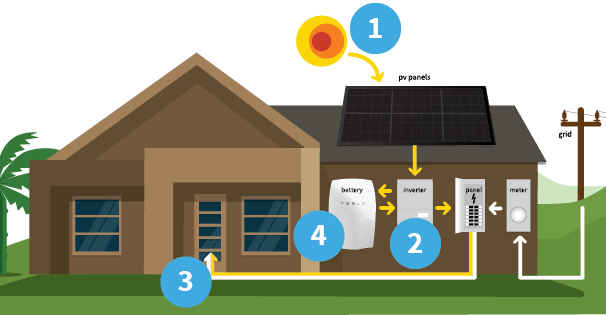
Net Metering lets you spin your electric meter in reverse
A solar electric system changes the dynamics of your relationship with the utility. As a Clean energy producer you
can "Net Meter" your electricity. In simple terms, if the solar system produces more energy than you are using at
that moment in time, your meter will spin backwards-crediting your account at the full retail rate. When your energy
needs exceed your system's output your meter spins forward. Your electric meter measures the "net" difference and
the utility company bills you for this amount.
(learn more about net metering)
What to expect
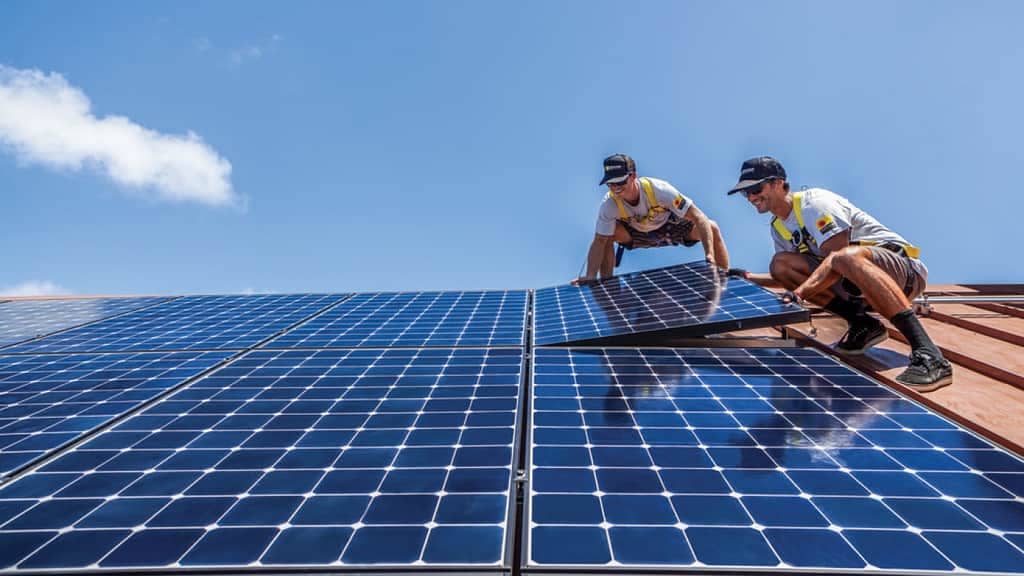
Rising Sun helps its customers meet their financial and clean energy goals by customizing a system that fits
their needs. Rising Sun makes it EASY. From initial consultation, system design, and installation, Rising Sun
provides a total turn-key process.
Here is how the the process works
Through a combination of average electrical usage and available roof space, a system is designed to meet your average
energy usage. Once equipment is procured, installation takes less than a week (for typical residential systems). Once
your system has been inspected and approved, your Rising Sun consultant walks you through system operation and system
monitoring. A month after installation we return to your home or business to inspect your system and calculate production.
On the anniversary of installation, we come back again for your first year inspection. Rising Sun can also install web
based system monitoring to insure system performance and send system alerts if there is a failure. Rising Sun warranties
all workmanship on its systems for 5 years residentially and 10 years commercially.
Note: There is no charge from the utility company to become a net-metered customer.
Call Rising Sun Solar for a free site survey and quote at 808.579.8287